
Everything you need to choose with confidence: what a lab-grown diamond is, how it is graded, which shape suits you and how big it will look.
What it is
A real diamond, grown above ground
A lab-grown diamond is made of the same carbon crystal as a diamond mined from the earth, so it has the same hardness, the same brilliance and the same fire. The only difference is its origin: it is grown in a controlled environment instead of deep underground over millions of years.
It starts from a thin slice of diamond, the seed. Carbon is then added to it, either layer by layer from a carbon-rich gas (CVD) or under the high pressure and heat that form diamonds in the earth (HPHT). After a few weeks the crystal is cut and polished like any other diamond.
Lab-grown diamonds are not simulants. Cubic zirconia and moissanite look similar but are different materials.
- Same crystalCrystallised carbon, chemically identical
- Same hardness10 on the Mohs scale
- Same sparkleLight performance depends on the cut, not the origin
- Different originGrown, not mined, and typically considerably lower in price for the same size and quality
To the naked eye, and even under a jeweller's loupe, the two cannot be told apart. Only specialist laboratory equipment can identify a diamond's origin.
How a diamond is graded
The 4Cs
Cut
How well the diamond is shaped and polished. It has the biggest influence on how much a diamond sparkles.
Colour
Graded from D (colourless) down the alphabet. Yellow, pink and olive stones are fancy colours, stated on the product page.
Our white diamonds: E–F, colourless
Clarity
How free the diamond is from tiny internal features.
Ours: VS, nothing visible to the naked eye
Carat
The weight of the diamond, not its size, although larger carats generally look larger.
Studs: always the total of the pair
Seven shapes
Find your shape

Round
The classic brilliant, with the most sparkle.
Shop round
Oval
Elongated and flattering; looks larger than a round of the same weight.
Shop oval
Pear
A soft teardrop, romantic and distinctive.
Shop pear
Marquise
Long and pointed at both ends; it elongates the finger.
Shop marquise
Emerald
Long step facets with a clean, architectural look.
Shop emerald
Radiant
A rectangle with brilliant facets: clean lines with fire.
Shop radiant
Princess
Square and crisp, with lots of sparkle.
Shop princess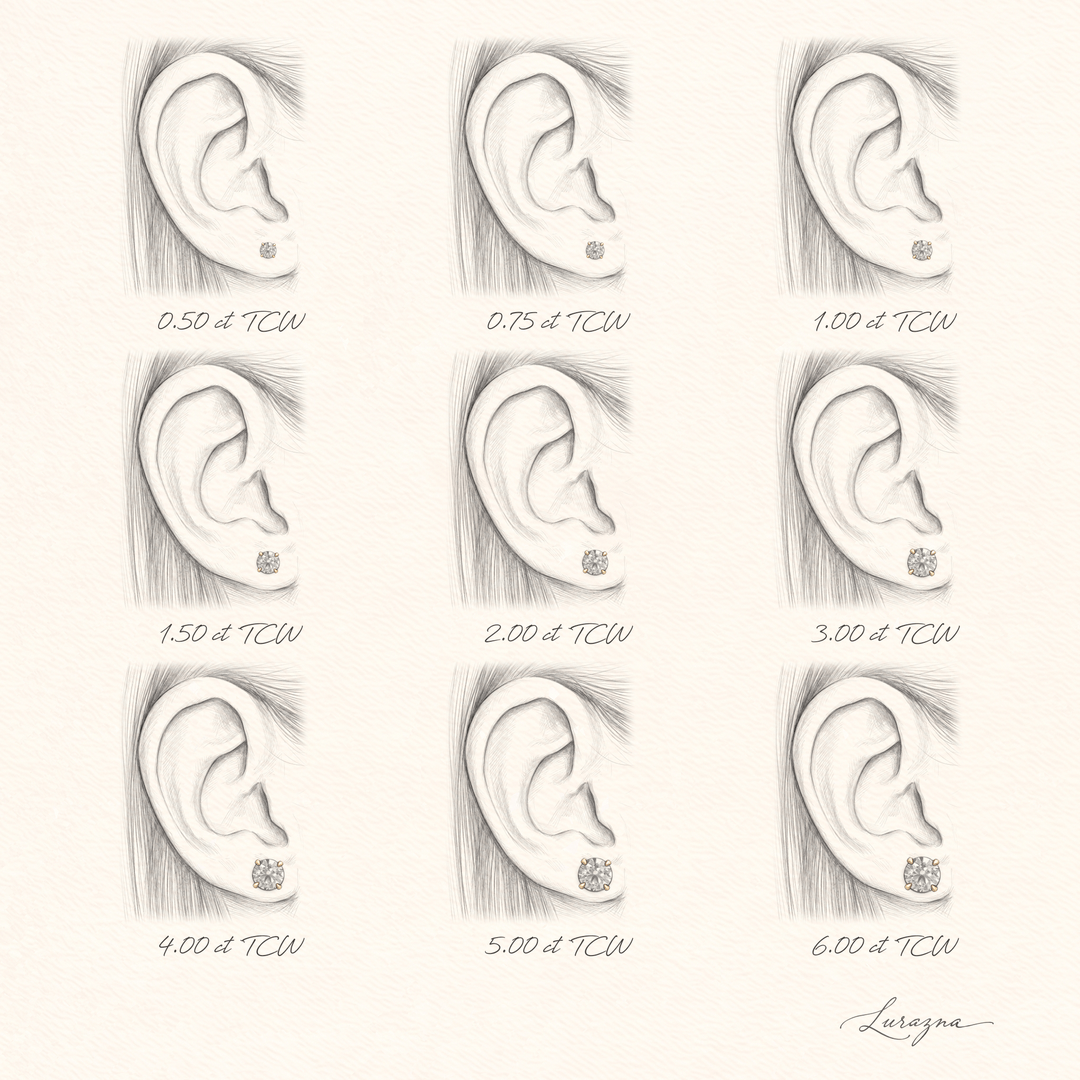
Carat on the ear
How big will it look?
Carat is weight, so the same carat can look different from shape to shape: elongated shapes such as oval, pear and marquise look larger than a round of the same weight. Here is the same weight, 1.00 ct total, in four shapes. Every stud page has a drawn chart like this one and the sizes for every carat.
| 1.00 ct total, studs | Each stone |
|---|---|
| Round | 5.0 mm across |
| Oval | 6.5 × 4.5 mm |
| Pear | 7 × 5 mm |
| Marquise | 8 × 4 mm |
Your certificate
Documented, piece by piece
Every LURAZNA piece comes with a certificate of authenticity describing the diamonds and the metal, which we email to you when your piece ships. Every diamond of 1.00 ct or more is also graded by IGI (International Gemological Institute), one of the world's leading independent gemological laboratories: the report number is on your certificate, and you can view the full report online.
Client Services
Frequently Asked Questions
Is a lab-grown diamond a real diamond?
Yes. It is made of the same carbon crystal as a mined diamond, with the same hardness, brilliance and fire. Only its origin is different.
Can a jeweller tell the difference?
Not by eye, and not with a jeweller's loupe. Only specialist laboratory equipment can identify whether a diamond was grown or mined.
Will it test as a diamond?
Yes. A lab-grown diamond is a diamond, so a diamond tester identifies it as one. Simulants such as cubic zirconia are different materials.
Will it change colour or turn cloudy?
No. A lab-grown diamond is as stable as a mined one. Like any diamond it can pick up dirt and lotion, so clean it now and then to keep it bright.
What comes with my piece?
Every piece comes with a certificate of authenticity, sent by email when your piece ships. Every diamond of 1.00 ct or more is also IGI-graded, with its report number on your certificate and the full IGI report online.
Still deciding?
Tell us what you have in mind and we will help you choose.